Showing posts with label atheism. Show all posts

Sunday, August 16, 2009

Obituary of James McCullen, XXIV (1935-2009)

Greetings.

Jewish date:  26 ’Av 5769.

Today’s holiday:  Twentieth Sunday of Ordinary Time.

Today’s quasi-holidays:  Watermelon Day, Bratwurst Festival, International Dadaism Month, Joe Miller’s Joke Day.

Worthy causes of the day:  “Harlequin Frogs Near Extinction as Temperatures Rise” and “Give Us an Open, Honest Debate on the Healthcare Crisis”.

Relevant to Divine Misconceptions:
  1. More religious oppression and intolerance:  “Mexico: Christians Jailed For Acteal Massacre Win Release”, “Suicide bombers target small religious group in Iraq”, “Boko Haram ressurects, declares total Jihad”.
  2. “Why I Think the New Atheists are a Bloody Disaster”:  Major rule:  No religious groups are composed of people with perfectly identical views.  This includes atheists.  This article is written by an atheist who does not approve of the recent “new atheism” movement.
  3. Nu, nu? Am I going to hear anything about my idea for spinning off a separate Divine Misconceptions blog?  Even something as simple as “Go for it” or “Bad idea” would be appreciated.
Today’s news and commentary:
Today’s weird thing is an obituary submitted by someone with a big gun, included below.  Enjoy and share the weirdness.

Aaron


JAMES MCCULLEN, XXIV (1935-2009)
The Fall of Destro:  An Obituary by the Cobra Commander
I remember the first time I set eyes on Jimmy McCullen.  It was 1969, just as men were taking their first steps on the moon.  I was a young cleric then, fairly brash and naïve and thinking that I knew all there was to know about our holy scriptures.  After all, wasn’t our god Golobulus everywhere and in everything?  So if I was well versed in all the words of his prophet Serpentor, then I must know everything worth knowing.  He who was then the Cobra Commander always chuckled at me, pleased at my zeal for the cause, even if he found me a bit deluded.
Jimmy was not.  His father, James McMullen, XXIII, was by then quite frail, and it had fallen on his son to run the family business.  Even Jimmy’s recent marriage had failed to mellow him.  He was formal to a fault in his manner, not just wooden as he greeted us, but stone-cold.  He met us at the airport with a vintage limousine, waiting for us with obvious impatience, as if the mere thought of just standing around was offensive.  For some reason he opened the door himself; we never saw the driver behind his partition.  Jimmy’s handshake was amazingly firm, almost as if his own hand was fashioned of steel.  Every word that burst through his lips was brief and emotionless, highly contained, as if he were some kind of robot.
There we were in the back of the limousine, Jimmy, the Cobra Commander, and myself.  The Commander’s words flowed freely, thanks and praises for having us and for the services we hoped he would provide, how blessed he must be by Golobulus.  Jimmy hardly looked at us, said only exactly what he had to say in precise terms, not a word more.  I wondered if the deal was falling through, that he was just going through the motions, perhaps to please his father, but in the end we would return with nothing.
For the next hour we toured one of his many warehouses, unassuming on the outside but quite full within.  Anything we could ever want was there, short of perhaps a nuclear warhead.  Jimmy claimed to be working on that.  Guns, bombs, grenades, survival gear, bullets, missiles, they were all packed in crates to the ceiling, every bit of space efficiently used, a masterpiece of organization.  And then there were all the vehicles parked there, rows of tanks, jeeps, small helicopters, and something that might have been a one-man clawed metal diving suit.  This was nothing, Jimmy claimed.  Next week it would be half-empty.  As much as peace and love were in fashion, so were war and hate, and there was plenty of business to go around.  I couldn’t care less if I had your business, was the message.
If the Cobra Commander was at all nervous, he never showed it.  He calmly noted he had contacts with other weapons suppliers, then noted how common were some of the merchandise were.  Everyone has AK-47s.  And these gas grenades, I know a man in Cairo who can get me something similar, maybe even cheaper.  Was this it?  Everyone spoke so highly of MARS and the McCullens.  Didn’t he have anything more?  Jimmy remained impassive as we rounded the warehouse, leading us back to the limousine with hardly a twitch, as if his own face were cast in metal.  And then he smirked as he looked at the Commander, just a slight lifting one of one corner of his mouth as he nodded, a sinister glint to his eye.  “Tux,” he said casually, tapping the hood of the limousine, “transform.”
The limousine jerked and shifted with a cacophony of pops and whirs, and I fell to my knees.  My head beneath my arms, I expected to be showered with hot metal and die right there, a seeming eternity of searing pain before my eternal reward.  But death never came, nor even the shower.  Hadn’t I seen it?  The limousine had come apart before my eyes.  The silence around me was almost as painful as the shrapnel should have been, unyielding and uninformative.  Curiosity finally won over fear, and I raised my head.
The Cobra Commander was just as shocked as I was at the bulk of metal towering over us.  The limousine had been replaced, pieces of it hanging off the outside of this thing which must have been twenty feet tall.  I was reminded of the robot in Metropolis, though this looked more like a man, with something like a top hat on its head.  There was a blue sheen to its eyes as it looked down on me, its shining metal face as impassive as Jimmy’s.  Tux, Jimmy explained, was one of his “iron grenadiers,” a mechanical race that was now in his employ.
Jimmy was always able to surprise me.  For all the years I have known him, from my ascent to being the Cobra Commander and beyond, he has always had something interesting to show me.  Not that everything always worked, of course.  There was always something special planned, some unforeseen trick or gimmick or angle that gave the man an edge to his dealings.  I might put my trust in Golobulus to provide, knowing how dire the situation is for the faithful, and then casually over coffee, just as you might mention some idiotic twaddle you saw on the television the other night, he would have some unbelievable find, just the supplies or ammunition to solve whatever problem we had.
Perhaps the most striking feature of the man was his dedication.  All men are dedicated in some way, some to their own pleasure, some to art, some to callings, others to Allah, Jesus, Golobulus, or whatever they may be calling the highest being.  Jimmy was truly dedicated to his work, and we sincerely appreciated it.
But even more than that, he was dedicated to his wife Anastasia.  Their courtship was something out of a romance novel, meeting under the backdrop of the civil war in Viet Nam.  She was but a young lady then, her parents refugees from the Third Reich who had done well in Canada.  Nobles, some said, others political leftists.  Her parents had begged her in vain not to volunteer as a nurse, they feared for her life, and rightly so.  She nearly died during the Tet Offensive, and it was only Jimmy riding in with some new weapons that saved her life, special ones he was demonstrating for the American military.  The bond was almost instant, and within a year he had made her his wife.
It was never an easy marriage between them, with families on both sides opposing it with many intrigues and threats to disown them.  And Anastasia herself has always been quite willful and fiery, not one to submit, not even to someone equally unyielding as her husband.  Breakable items had a short life expectancy around her.  Rare was the man who could stand up to Anastasia McMullen, and though we are lucky enough to count her among the faithful, I have seen her make even battle-hardened soldiers cry.  And as stormy as her temper was, she was as sharp and brilliant as her husband and an even more vicious debater.  It is a mark of his dedication and passion that he weathered what no other man could.
It is an open secret that the G. I. Joe toy franchise (the action figures, not the dolls) is loosely inspired by both Jimmy’s family firm, the Military Arms Research Syndicate, and the faithful of Golobulus and his prophet Serpentor, the Cobra Organization being just a military wing of such.  It may seem odd that a man like Jimmy would tolerate what must seem like mockery.  Many wealthier men have not, as William Randolph Hearst did when Orson Welles fictionalized the former’s life in Citizen Kane.  And while Jimmy was indeed a proud man, and rightly so, he never let his pride get in the way of good business.  Just as the fast food industry has ingratiated itself into people’s lives through children, so did Jimmy realize that he could do the same.  With the help of his wife and the iron grenadier Loki, they came up with the premise of the cartoon, comics, and action figures.  Jimmy would be a major baddie, vying to rule the world.  We took his doppelgänger’s outfit from one he wore at a costume ball, with leopard fur and leather and a shiny mask that would become his trademark, one that got him nicknamed “Pimp Daddy Destro” for years after that.  Destro’s love was called “the Baroness” after a nickname a servant once called Anastasia (and thereafter rightly earned the servant a beating), her jumpsuit drawn from the same ball that produced the other costume.  (She was actually trying to dress as Mrs. Emma Peel of The Avengers.)  And as for myself, by then ascended to the Cobra Commander, I got a sharp uniform and a spiffy mask totally unlike anything I’ve ever worn and a degree of incompetence I am incapable of.  (The character was actually an homage to Yosemite Sam.)  Together we would be bickering and disunited, constantly trying to conquer the world by outlandish means.  And fighting Cobra would be the alleged good guys, an elite force called G. I. Joe.  Their disarray of uniforms being anything but military, somehow this bunch of oddballs with no real coordination was supposed to work as one.
It was all very silly and supposedly innocent fun, but it was full of psychological traps.  Cobra is quite genuinely an enemy of the United States, but if who would worry if Cobra never seems to win?  Cobra was evil, but what about them was evil was never explained or even shown.  And the so-called Joes always charge in and save the day, regardless of the odds.  Even while he feigned outrage over the whole thing, he secretly was amused at the elegance of it all.  Not only were Cobra and MARS now well known, but generally thought harmless.  Our missionaries found youth painfully ignorant of the true nature of Golobulus and, never having seen the need to exercise their minds before the “obvious,” could not stand to the slightest challenge.  Our faithful in the West subsequently rose.  And those assurances of safety in the hands of the military were nothing but false hope.  The Joes were a bunch of superheroes, a few ultra-powerful beings who can overcome anything.  The myth of the superhero is quite enduring in the West, idealized despite their unreality.  Police to not employ masked acrobats or strongmen to go out by themselves and deliver vigilante justice, for the problems are too many and would lead to chaos.  No certain rescue there.  Note how the armies of the United States and Great Britain have yet to destroy al-Qaida or capture Usama bin Ladin; how absurd to think a handful of even the best soldiers could do better.  By teaching such unrealistic expectations to the Western youths, ultimately we have a much safer world for Cobra and all the faithful.  Although Jimmy feigned fury every time there was this new action figure or that new series that he claimed impinged on his honor (one of his public rants over Sigma Six was truly a masterpiece), that was only part of the ruse.  Anger always made for good gossip, and gossip spreads news.  Secretly he was often hysterical that he was able to manipulate the minds of an entire generation, a supreme joke if there ever was one.
The recently released movie, G. I. Joe:  The Rise of Cobra is no different.  Indeed, the very title is deceptive, for Cobra appears nowhere in it.  The contest is merely between the Joes and Jimmy, and it is taken to absurd heights.  Nothing in this movie is remotely plausible, and indeed it has the right ingredients for a camp classic.  G. I. Joe is now an international team; perhaps the Americans feel shame being so after their country’s fiascoes in international affairs.  The team includes a variety pack of unlikely members, from a jet-flying soldier who coattails his way in, to a Caucasian ninja who has taken a vow of silence, to a supergenius who just who just happens to speak Celtic and whose body armor lifts and separates.  The baddies are now presented in even more distorted form.  It has Jimmy (played by Christopher Eccleston) as a weapons manufacturer, and the movie does capture some of his sternness and determination.  But the movie also presents him as trying to take over the world, which he never did, and never cared to.  My own self (played by Joseph Gordon-Levitt) was presented as a stereotypical disfigured mad scientist with no connection to either the comic-book character or myself.  Anastasia was reduced to “Ana Lewis,” a former fiancée of one of the Joes who has since turned evil, as signified by dyeing her hair black and dressing in black and glasses.  Utterly ridiculous connections are drawn between the three.  The evil scientist who poses as me uses “nanomite” technology to control minds.  Anastasia becomes my sister, controlled like a puppet into serving the military and sexual interests of Jimmy.  (Personally, I think that destroys the character’s charm, her being a robot.)  In the end this same man disfigures Jimmy with his nanomites into having a metal head, puts on his own mask (which is quite ugly), and calls himself “Commander,” all without any real claim to the position.  There is no rise of Cobra, for in the end there is no Cobra, this so-called “Commander” and Jimmy being utterly defeated.  Meanwhile the Joes, with preposterous technology, abundant teamwork, and the power of true love, rise up over Jimmy’s minions and completely obliterate them.  I could complain about a number of absurd places and events in this movie.  It has bases under the desert near the pyramids of Giza and under the ice in the Arctic Ocean.  Weapons range from guns which project some kind of air distortion to mechanical suits which allow one to run and jump at fantastic speeds.  Massive public disregard for human life is portrayed without any cries for war crimes tribunals.  And as Eccleston has previously played the title character in the revived Doctor Who series, whenever he opened his mouth, I expected to hear such phrases as “Let’s see how well the Joes stand up to the Daleks” or “I’ll just deactivate that fancy jet plane with my sonic screwdriver.”  But deep down it was all the same pattern as the cartoons:  the good guys win no matter what, while the bad guys always bicker, turning on each other and getting nowhere.  Watch it enough and maybe you’ll soon believe it.  I certainly know some world leaders who do.
The real Jimmy was full of surprises to the end.  The world media have been slow to provide details on his death, and I shall be glad to supply them.  His iron grenadiers may have added to his wealth but also to his torments.  As it turns out, the larger tribe of these beings do not want their brothers on Earth, and they have come to fetch them back.  Mostly they have been cowards about it, sneaking about and snatching them away one by one.  It was no accident that when Jimmy sent the bulk of them to serve the United States, he insisted they be housed in a protected location well within the country’s borders.  (In any case, there’s more room for them at Area 51 than at Guantánamo Bay.)  Their slow drain of numbers was a constant irritant, but taking a public side, even against these “invaders” and “thieves” as he called them, was not in his nature.  (He always liked to play the neutral third party as an arms dealer.)  It was only when the iron grenadier he called Convoy was publicly humiliated and taken away that he finally had enough, doing what his wife could never do.  Convoy was a key part to the publicity of the iron grenadiers, and there would be no way he could accept the loss.
He asked me for a favor, and I was happy to oblige.  With the help of a Cobra submarine and a missile he supplied, we aided his iron grenadiers attack his enemy.  We damaged their floating fortress, killed quite a few, and let the iron grenadiers satisfy their own bloodlust and rescue their imprisoned comrades.  The operation was fast, for soon their enemy’s soldiers returned from their own rounds, and a battle ensued.  Our submarine retreated to the safety of the depths, happy to help a friend in need.
I believe he expected things to turn out differently.  Not quite so many of his iron grenadiers were liberated as he expected, though his precious Convoy and the military genius Meister were among those who returned.  Up until then, no one wanted to challenge the “bloody bastard thieves,” there were so many unknowns, and what was known suggested staggering losses would occur.  Showing them to be vulnerable would make them seem less scary, and for a moment it did.  They have whined and complained at the United Nations and in the Hague for justice, but hardly any country has seen it fit to validate their cause.  They pleaded with Britain to extradite Jimmy and were ignored.  Jimmy was hysterical.  He had called the biggest bluff in history, punched a giant gorilla in the nose and simply walked away.  Suddenly even pirates who usually prey on freighters were emboldened enough to take his enemy on.  For the longest time his spirits were high, that is, until the night they came for him.  
If he made a mistake, it was his thinking “those steely gits” would always stick to diplomacy.  But even someone as stern and patient as they are has his limits.  It was just hardly a week ago that it happened, when a thick fog rolled over his estate, and then his enemy appeared, ready to deal with any security measures he had and more, save one.  For years Jimmy tried to reverse engineer the weapons the iron grenadiers brought with them without success, but that never stopped him trying.  And he did keep one for his personal use.  Jimmy had that one last surprise waiting, one that put him on a more equal footing with his enemies.  Not equal enough, sadly, for by the time the Royal Air Force was able to respond, it was already over.  Half of his mansion was reduced to char and rubble, the underground bunker torn open.  Anastasia had been taken, alive apparently, while his servants and personal security forces had fled in terror or been knocked unconscious by unknown means.  The spot where Jimmy had made his stand was utterly obliterated.  The only one there who had seen anything was his granddaughter Caroline, there on a visit, and she was hardly any use to the military.  They took her! she screamed.  They took Grandmama!  The bloody metal bastards took her!
I am writing these final lines, not from my desk, but from the back of a private jet as I hurry away from my beloved Cobra Island.  Not long ago I received word that a very large number of aircraft were approaching, and I doubt they’re friendly.  Our warriors will fight bravely, and no doubt many will find their eternal reward, but I fear this battle is lost.  But it is not the battle that matters, but the ongoing struggle.  For there is no war where a machine can overcome the divinely given human soul, and I believe as firmly as ever this is one we shall win.  Thank you, Jimmy for all your help.  May Golobulus seat you with all the faithful martyrs at the right hand of Serpentor.
And now I must go.  The bloody metal bastards are coming.

Wednesday, August 5, 2009

Beware of Sam Harris

Greetings.

Jewish date:  15 ’Av 5769.

Today’s holidays:  15 ’Av (to be forgotten by Jewish men with women in their lives at their own peril), Dedication of St. Mary Major.

Today’s quasi-holidays:  National Mustard Day.

Relevant to Divine Misconceptions:
  1. In lieu of a weird thing today will be a review of the militant atheist text Letter to a Christian Nation.  See below.
  2. “Orthodox Judaism Must Lead to Moral Behavior”:  More introspection of one’s own religion.
  3. More religious intolerance:  “TIMELINE: Ethnic and religious unrest in Nigeria”, “Nigerian police probe clashes that killed 700”, “Pakistan Christians shut schools to mourn killings”, and “'They Want to Destroy Christians'”.
  4. “'Gaza man killed daughter for owning phone'”:  I have mentioned this case before, and this article  gives a reason for the murder:


    The groups' reports said that the assault was triggered by Jawdat Najjar's discovery that his daughter Fadia - a 27-year-old divorced mother of five - owned a cell phone. He suspected she used it to speak to a man outside the family, according to the groups' reports.
    Note honor-killing was done over a mere suspicion of talking to someone improper, not evidence of any impropriety worthy of death.  This is why, as I keep saying, taking the law into one’s own hands is a bad idea.  For all anyone knew, the poor woman was innocent.
Today’s news and commentary:
And now for the review.  Enjoy and share the weirdness (or be scared or disgusted or something).

Aaron


Redefining morality:  a review of Letter to a Christian Nation
by Aaron Solomon Adelman
Your humble reviewer is going to get through what seem to be the most important books of the militant atheism (= evangelical atheism, new atheism) movement, whether he likes it or not.  Letter to a Christian Nation by Sam Harris (Harris 2006) is one which was inspired by and spurred on by Richard Dawkins’s The God Delusion (Dawkins 2006), and unfortunately it repeats many of the same mistakes (e.g., paranoid religion-bashing and a venous disgust for religion which permeates every single original sentence), which will not be repeated here because what was wrong in The God Delusion is perforce still wrong in Letter to a Christian Nation, and your humble reviewer has better things to do than repeat himself.  However, Letter to a Christian Nation is not a complete copycat either, as it makes its own original errors.

Problem 1:  Redefining morality.

Harris, like Dawkins, gives Christianity a negative moral evaluation.  Dawkins, as mentioned in this reviewer’s review of his book, never really defines morality.  Harris, on the other hand, does define his moral system:  “Questions of morality are questions of happiness and suffering” (Harris 2006, p. 8).  This is the whole foundation for his moral system, and anything which he perceives as causing unhappiness, suffering, and needless death he labels as immoral.  Harris is correct, at least to some degree, that we can make objective claims about happiness and suffering (Harris 2006, pp. 23-25).  However, he still misses my major point about morality:
MORALITY IS A MATTER OF OPINION, NOT FACT!
Who told Harris that morality must be defined in terms of happiness and suffering?  For that matter, why would one think morality has to be defined in terms of happiness and suffering?  Not only do your humble reviewer’s comments on morality in The God Delusion hold, but Harris’s system fails on two accounts.  

1) The first problem is that this is an arbitrary opinion, so if he wants other people to adopt it, it is his duty to convince others to accept it.  He never does.  He just assumes he is right and bashes away.  And since he does nothing to prove his system is the “one true moral system” (which is not meaningful, since one cannot prove an opinion), anyone can reject it without having to give the least justification.

2) Harris’s moral system is the wrong one to use on his alleged target audience.  Remember, this book is supposed to be A Letter to a Christian Nation.  If one wishes to make moral arguments to Christians, one has to work within a moral framework acceptable to Christians.  This is why when Christians argue about morality they do it in reference to the Christian Bible; since they accept it as a basis for morality, one can make arguments based upon it which are persuasive to Christians.  Harris, however, cannot use the Christian Bible as a basis for what is right and wrong, because anything the Christian Bible says is right is going to be accepted as right by Christians.  This makes it illogical to use the Christian Bible as a moral basis to attack Christianity and be accepted by Christians.  Unfortunately, Harris’s use of his own moral system, even if his factual claims about Christianity were correct, makes him unable to articulate a moral argument that Christians must accept.  To put it colorfully, he’s damned if he does, and he’s damned if he doesn’t.  Ignoring the fact that he is doomed to fail no matter which moral system he chooses, Harris goes ahead anyway and tries to make an argument against Christianity on one of the worst bases ever attempted:

Problem 2:  Mistaking (alleged) immorality for falsehood.

Suppose for a moment that one accepts Harris’s negative moral evaluation of Christianity.  Does this have anything to do with the question of whether Christianity is true?  Absolutely not.  It is still conceivable that Christianity is true.  The Christian God, if He really does exist, is as entitled to have moral opinions as anyone else, and there is no reason He has to follow Harris’s moral opinions.  The truth or falsehood of Christianity—or any other religion—depends on whether its essential claims are true, not how anyone feels about them.  Harris, however, barely goes beyond mistaking moral outrage for proof or (following Dawkins) attacking a straw man version of Christianity.  He does make one attempt at attacking the New Testament for being written to make it look like prophecies from the Hebrew Bible are being fulfilled and there being disagreements among the Gospels (Harris 2006, pp. 57-59), but then he lapses into complaining that prophecies are not written the way he wants them to be written, including giving an untenable interpretation of 1 Kings 7:23-26 and 2 Chronicles 4:2-5 that π =3 which only someone completely ignorant of mathematics would believe (Harris 2006, 59-62), and degenerates into another straw man attack after that.

Problem 3:  Who is the real audience for this book?

The title of this book is Letter to a Christian Nation.  Early on Harris claims to be addressing specifically conservative Christians, which he defines as people who believe “that the Bible is the inspired word of God and that only those who accept the divinity of Jesus Christ will experience salvation after death” (Harris 2006, p. viii).  While not explicitly targeting non-conservative Christians or non-Christian religious people, Harris accuses them of giving “shelter to extremists of all faiths” and lending “tacit support to the religious divisions of the world”, yet claims to envision liberal and moderate Christians ganging up with nonbelievers against conservative Christians (Harris 2006, pp. ix-x).  However, Harris’s style of argumentation (“you are horrible people, and your religion is utterly repulsive”) is extremely badly calibrated to win any converts (or in this case, apostates) from any religious group.  The problem is made worse by Harris’s failure to even try to understand conservative Christianity as conservative Christians understand it.  Letter to an Christian Nation is, in fact, so abrasive and insulting to religion and religious people that few of its alleged target audience are likely to bother to reading more than a few pages, if they read any of it at all.  Given that Harris managed to get into a PhD program in the natural sciences, he is presumably sufficiently intelligent and aware of how humans think to know that this book’s chance of success among adherents of any religion other than atheism are negligible.  The most likely explanation your humble reviewer sees is that this is actually a book for rabid atheists who hate conservative Christianity, much like Dawkins’s The God Delusion, and its claim to be a letter to a Christian nation is a transparent pretense.

Problem 4:  Poor book design.

This is not a matter of fallacy or getting the facts wrong.  However, trying to find anything in a book which has no table of contents or index is a pain in the neck.  If your reviewer had not followed his standard procedure of folding over corners at notable passages and writing in margins, he would not have been able to find anything again after reading it.  Furthermore, there are few footnotes, even fewer of which give sources.  A listing of sources is found at the end on the book (Harris 2006, pp. 93-96), but these do not cover everything claimed.  For someone who is working on a PhD in neuroscience (Sam Harris), this is inexcusable.  There is a major rule in academia that one is supposed to source all of one’s nontrivial claims.  And while it is easy to fail to achieve this ideal, never has the author ever read another book from an academic (real or alleged) which ever made it so hard to find material on a specific topic.  This is exactly how a book is put together in order to keep anyone from keeping track of what the author is claiming or doing fact-checking.

Conclusion:  Letter to a Christian Nation is, like The God Delusion, grandstanding for theism-hating atheists with little or no interest in reason.  Harris ought to have learned from Dawkins’s deficiencies, but instead he repeats many of the same mistakes and a few of his own.  The only people who have any need to read this book are those doing research on militant atheism or Sam Harris.

Overall classification:  Worthless outrage professing to be reason.

Theological rating:  F, with a recommendation that Harris be banned from theology and logic until he repents and demonstrates that he understands the Christian Bible competently.

Bibliography: 
Dawkins, Richard. 2006. The God delusion. Boston: Houghton Mifflin Co.
Harris, Sam. 2006. Letter to a Christian nation. 1st ed. New York: Knopf.
Sam Harris [Web-site] [cited 2009-08-02. Available from http://www.samharris.org/.


Reblog this post [with Zemanta]

Tuesday, July 7, 2009

The meaning of life

Greetings.

Jewish date:  15 Tammuz 5769.

Today’s holiday:  Tuesday of the Fourteenth Week of Ordinary Time.

Today’s quasi-holiday:  Father and Daughter Take a Walk Day.

Worthy cause of the day:  “A NUCLEAR FREE WORLD”.

Relevant to Divine Misconceptions:
  1. “ISNA's Reform Hasn't Shed It of Radical Ideologues”:  Whether or not the “true” Islam, is pro-terrorism, people who are pro-terrorism are not our friends and should not be treated as such.
  2. “World's oldest Christian Bible digitized”:  (Submitted by David.)  The Codex Sinaiticus, a copy of the Christian Bible in Greek from the 4th century, has now been made freely available on-line.  This should be a boon to scholars.
  3. “TV gameshow offers atheists 'salvation'”:  This is at best in poor taste.  Religion is about the truth, not a contest for followers.
  4. More intolerance:  “Three die in Karnataka violence” and “Faisalabad, a Christian tortured and detained on false charges of blasphemy”.
  5. For those of you who were wondering about the Ethiopian Orthodox Church revealing the Ark of the Covenant, they claim they were not going to do that.  See  “Ethiopian Ark of the Covenant Not To Be Revealed After All”.
Today’s news and commentary:
Today’s weird thing is a little religious humor:  “LOLZ, Cheezebugers and Naps?”.
funny pictures of cats with captions
Enjoy and share the weirdness.

Aaron

Thursday, May 21, 2009

Beware of the Death Star

Greetings.

Jewish date:  27 ’Iyyar 5769.

Today’s holidays:  Day 42 of the ‘Omer, Ascension.

Today’s quasi-holidays:  World Day for Cultural Diversity for Dialogue and Development, National Bike to Work Day.

Worthy causes of the day:  “Tell Congress you want action on global warming” and “Support Clean Water and Sanitation”.

Relevant to Divine Misconceptions:
  1. “South Bend buses to carry atheist ads”:  Atheists in Indiana are advertising on buses “You can be good without God.”  Big deal.  Yes, you might be able to be good without God, but that depends on what definition of “good” you use—which might have believing in God as a requirement—and in any case, even if one claims that one can be good without believing in God, being an atheist does not make one intrinsically more good (unless one has a moral system which makes it axiomatic that not believing in God is better than believing in God).  Someone please teach atheists how to do PR, especially the obvious fact that a single sentence is a very small amount of material to work with to make a moral point.
  2. More persecution:  “US priest killed in robbery in Guatemala”.
  3. More unsubstantiated accusations:  “Abuse of child 'witches' on rise, aid group says”.
  4. “Islam Day and the Year of the Bible in America”:  Um, aren’t such events an obvious violation of separation of church and state?
  5. More of the saga of the 13-year-old who refused chemotherapy for Hodgkin’s lymphoma on religious grounds:  “Boy's mother faces arrest over chemo refusal”.
Today’s news and commentary:
Today’s weird thing is “Death Star Destroys Enterprise”.

I have no clue what the point of this is.  Other than the creator probably thinks Star Wars is better than Star Trek.  Enjoy and share the weirdness.

Aaron

Tuesday, May 19, 2009

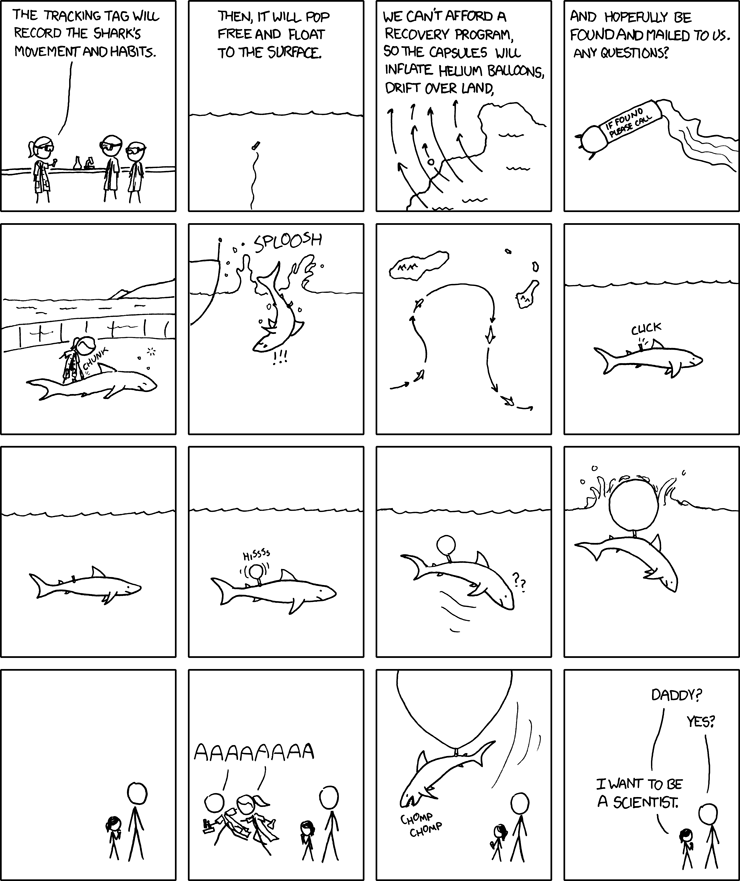
Beware of shark

Greetings.

Jewish date:  25 ’Iyyar 5769.

Today’s holidays:  Day 40 of the ‘Omer, Tuesday of the Sixth Week of Easter.

Today’s quasi-holiday:  Bike to Work Day.

Worthy causes of the day:  “Tell BLM no more public lands for the world's dirtiest fossil fuel!” and “SAY NO TO U.S. PRESSURE ON ISRAEL”.

Relevant to Divine Misconceptions:
  1. “After the Rapture: Orlando man will deliver messages to those left behind” and the associated site, The Post-Rapture Post - Send Messages to Loved Ones!:  An atheist set up a joke site offering for a fee to deliver messages to people left behind after the Rapture.  Strangely enough, people actually placed orders.  Go figure.
  2. A bit of relief:  “Well-known Canadian imam issues fatwa against Taliban”.
  3. Yet another view of that 13-year-old boy with Hodgkin’s lymphoma refusing chemotherapy for religious reasons:  “The case of chemotherapy refusenik Daniel Hauser”.
  4. An article clearing up a common confusion:  “Satanism vs. Wicca: Two alternatives, often confused, little in common”.
Today’s news and commentary:
Today’s weird thing is the cartoon “Outreach”.
Enjoy and share the weirdness.

Aaron

Sunday, April 26, 2009

Beware of Richard Dawkins

Greetings.

Jewish date:  2 ’Iyyar 5769.

Today’s holiday:  Day 17 of the ‘Omer.

Today’s quasi-holidays:  Shuffleboard Day, National Pretzel Day, Landscape Architecture Day, World Intellectual Property Day, Hug an Australian Day.

Relevant to Divine Misconceptions:
  1. Thank YHWH, I now have a review of Richard Dawkins’s atheistic opus The God Delusion, presented below in lieu of a weird thing.  I only wish I had read this book before I participated in the panel for Darwin Week.  Now, somebody bug me to watch the latest two episodes of Kings and review them, too.
  2. “Zimbabwe: Four 'Prophets' Arrested Over Drowning”:  General rule:  whatever you do in the name of religion, do not do it stupidly.  If someone drowns, baptism is being done wrong.
  3. “Institute sues Texas college board over master's degree”:  The Institute for Creation Research Graduate School is suing the Texas Higher Education Coordinating Board, claiming they should be allowed to grant Master of Science degrees.  This is just the latest in a long series of lawsuits aimed to allow dishonest people to pass off creationism as legitimate science.
Today’s news and commentary:
And now, without further delay, I present my review of The God Delusion. Enjoy (or be scared or something) and share the weirdness.

Aaron


Delusional victory:  a review of Richard Dawkins’s The God Delusion
by Aaron Solomon Adelman
“The Babel fish,” said The Hitchhiker’s Guide to the Galaxy quietly, “is small, yellow and leech-like, and probably the oddest thing in the Universe. It feeds on brainwave energy not from its carrier but from those around it. It absorbs all unconscious mental frequencies from this brainwave energy to nourish itself with. It then excretes into the mind of its carrier a telepathic matrix formed by combining the conscious thought frequencies with nerve signals picked up from the speech centres of the brain which has supplied them. The practical upshot of all this is that if you stick a Babel fish in your ear you can instantly understand anything said to you in any form of language. The speech patterns you actually hear decode the brainwave matrix which has been fed into your mind by your Babel fish.

“Now it is such a bizarrely improbable coincidence that anything so mindboggingly useful could have evolved purely by chance that some thinkers have chosen to see it as the final and clinching proof of the non-existence of God.

“The argument goes something like this: ‘I refuse to prove that I exist,’ says God, ‘for proof denies faith, and without faith I am nothing.’

“‘But,’ says Man, ‘The Babel fish is a dead giveaway, isn’t it? It could not have evolved by chance. It proves you exist, and so therefore, by your own arguments, you don’t. QED.’

“‘Oh dear,’ says God, ‘I hadn’t thought of that,’ and promptly vanishes in a puff of logic.

“‘Oh, that was easy,’ says Man, and for an encore goes on to prove that black is white and gets himself killed on the next zebra crossing.

“Most leading theologians claim that this argument is a load of dingo’s kidneys, but that didn’t stop Oolon Colluphid making a small fortune when he used it as the central theme of his best-selling book Well That About Wraps It Up For God.

“Meanwhile, the poor Babel fish, by effectively removing all barriers to communication between different races and cultures, has caused more and bloodier wars than anything else in the history of creation.”
—The Hitchhiker’s Guide to the Galaxy by Douglas Adams (Adams 1989, p. 42)

Dr. Richard Dawkins is a militant atheist, and The God Delusion, as he claimed in Expelled:  No Intelligence Allowed (Frankowski 2008), is supposed to be his great attack against religion in general and especially belief in the existence of gods (theism).  He is opposed to every god worshipped by every religious person, and so he purportedly takes it upon himself to try to prove to the reader that atheism is correct (at least within the tolerances of what is knowable).  In addition to being an atheist, Richard Dawkins is an eminent, respected evolutionary biologist.  As a scientist, one would think he would stick strictly to evidence and the uncompromising rule of logic, perfect deductions and well-justified inductions and abductions.  Anyone who can create scientific writing is capable of this.

And yet Dawkins takes a radically different route.  What he produces instead is in the spirit of Ann Coulter’s Godless:  The Church of Liberalism (Coulter 2006), Ben Stein’s Expelled:  No Intelligence Allowed, and Anton Szandor LaVey’s The Satanic Bible (LaVey 1969).  Rather than arguing with his opponents, Dawkins argues at them, and by this your humble reviewer means something analogous to the difference between “laughing with” versus “laughing at”.  If Dawkins were arguing with his opponents, he would have kept his emotions under strict control, carefully researched theism, tried to throughly understand what the best of his opponents actually believe, analyzed their beliefs, and tried to show conclusively why they are wrong.  Instead Dawkins argues at his opponents.  Dawkins has done little research on what his opponents actually believe, especially those of theists who are intelligent, knowledgeable, and have carefully thought out their belief systems; what Dawkins argues against is actually a shallow, stereotyped version of Abrahamic theism in general and Christianity in particular.  His arguing against the alleged views of his opponents is paradoxically short on relevant points and sloppy yet long on verbiage.  And rather than do a good job on arguments, Dawkins instead resorts to ridicule and insults, going on and on proclaiming a false dichotomy of how wonderful and intelligent atheists are and what a bunch of immoral idiots theists are.  This is not a book meant to convince theists to become atheists, but rather a book for uncritical atheists to rally around.  And the problems that show through because of this are serious.

Problem 1:  Dawkins confounds creationism and theism.

Richard Dawkins is an eminent, respected evolutionary biologist.  If there is one sort of person which evolutionary biologists hate, it is creationists.  It is not merely that creationism/“intelligent design” is in contradiction to evolution.  Creationists rarely demonstrate any understanding of evolution or what is wrong with creationism.  Even worse, they fail to learn that they are wrong.  Despite the repeated debunking of creationist claims, they do not modify their positions, but rather shift their tactics to make the same, exact biological claims.  As this reviewer has noted previously, some creationists are even slanderously dishonest in the promotion of creationism.  As such, evolutionary biologists have every cause to be justifiably disgusted at and frustrated with creationists.  But rather than honestly tackle creationism specifically, Dawkins instead claims he is attacking theism in general.

If Dawkins truly were trying to disprove theism, he would need to carefully specify an hypothesis to examine which covers every single god.  This is a tall order.  Gods can be anything from a delusional mortal to ultimate reality.  An hypothesis taking on all gods needs to cover monotheism, dualism, trinitarianism, polytheism, deism, pantheism, panentheism, transcendent theism, ancestor worship, animal worship, deified humans, suitheism, and probably a number of other distinct isms as well.  Such an hypothesis needs to cover YHWH, the Christian Trinity, Allah, the corporate God of Mormonism, the hidden god and demiurge of Gnosticism, the millions of gods of Hinduism, the gods of Jainism, the Horned God and Triple Goddess of Wicca, the Pantheon of ancient Greek religion, the gods of the ancient Romans, the gods of the ancient Egyptians, the gods of the Mayans, the gods of the Aztecs, and the gods of every other religion.  Dawkins claims he is against all these (Dawkins 2006, p. 36), yet instead he specifies this hypothesis:  “there exists a superhuman, supernatural intelligence who deliberately designed and created the universe and everything in it, including us” (Dawkins 2006, p. 31).  This definition does not cover all gods, but only the existence of a single God defined according to creationist conceptions.  The alternative is not even defined as a simple negation of this (alleged) “God hypothesis”, but rather as “any creative intelligence, of sufficient complexity to design anything, comes into existence only as the end product of an extended process of gradual evolution” (Dawkins 2006, p. 31).  In other words, Dawkins is claiming that either the creationists are right or he—a militant atheist—is right.  Since there are many other obvious possibilities—such as there could be a god who created the universe but did not deliberately design everything in it—this is a false dichotomy.  Such a fundamental error alone should be a warning sign that something is horribly wrong with this book.  And indeed there is.

One obvious problem is that the redefinition of what constitutes a god screws up the definition of agnosticism.  Dawkins distinguishes between two sorts of agnosticism:  permanent agnosticism in principle (PAP), which science cannot adequately address, and temporary agnosticism in practice (TAP), which there is hope that science may address at some point (Dawkins 2006, pp. 47-48).  Since creationism is disprovable (and has been disproved) and thus any sufficiently intelligent, knowledgeable, and intellectually honest person must eventually come to realize it is wrong, anyone who is agnostic about creationism must be classified as a TAP creationist.  Yes, every good scientist is aware that anything and everything he/she believes in principle could be should shown to be wrong, but the evidence against creationism is so strong that this doubt is more pro forma than something to be seriously taken into account.  The problem arises in that since Dawkins wrongly equates theism with creationism, he also wrongly equates agnosticism of religion with agnosticism of creationism.  This puts Dawkins in the awkward position of trying to explain the existence of agnostic scientists—very respectable agnostic scientists—without revealing that they are agnostic with regard to theism and not agnostic with regard to creationism.  Rather than honestly admit he is using different definitions, Dawkins weasels his way out of the problem.  He lies that agnosticism is TAP because God could prove his existence by an open miracle (Dawkins 2006, p. 50), completely ignoring that there is nothing one can do to force a being who is not of our universe—and therefore exempt from our physical laws—to do anything, thus making agnosticism of theism effectively PAP.  Even worse, Dawkins uses two loaded words rather than acknowledge the truth:  “I suspect”.  For example, he explains how Bertrand Russell once fell for the ontological argument by saying “I suspect that he was an exaggeratedly fair-minded atheist” (Dawkins 2006, p. 82).  To explain the agnosticism of T. H. Huxley (the man who invented the term “agnosticism”), Dawkins says “I suspect that when he appeared to do so he was bending over backwards to concede a point, in the interests of securing another one” (Dawkins 2006, p. 50).  Stephen J. Gould receives the same treatment with “I simply do not believe that Gould could possibly have meant much of what he wrote in Rocks of Ages” (Dawkins 2006, p. 59), in reference to Gould’s doctrine of nonoverlapping magisteria, which posits that religion and science do not ever truly step on each other’s toes.  Keep in mind that suspecting and disbelief is not proof of anything, as one can suspect or disbelieve anything.  And the fact that he has to suspect this much to keep up the illusion of his false dichotomy is very suspicious indeed.

Confusing theism and agnosticism also screws up Pascal’s wager (Dawkins 2006, pp. 103-105).  Since it is unacceptable to realistically take creationism into account, Dawkins cannot possibly accept that it is worth betting on the possibility that there might be a god.

Also bad is the problem of scientists, such as Eugenie C. Scott (Dawkins 2006, p. 66), who work together with theists, the very people Dawkins considers the enemy.  Even worse are religious scientists, especially religious biologists, even more especially his own colleagues.  He acknowledges the problem, but he never truly discusses their reasons for believing in a religion.  To explain why Francis Collins (Dawkins 2006, p. 99) or Kenneth Miller (Dawkins 2006, p. 131) believe in God would be tantamount to admitting that creationism and theism are not equivalent and that neither implies the other.  And so Dawkins ignores anything they might have to say on the subject and hopes no one notices.  He also tries to play the “I suspect” card to deny they are really religious (Dawkins 2006, p. 99).  The best Dawkins tries to do is portray atheism and science as going hand-in-hand.  E.g., he notes that only 40% of American scientists and 7% of scientists in the National Academy of Sciences are religious (Dawkins 2006, p. 100), as if popularity among the “right” crowd were the same thing as truth.  Alternative explanations, such as that many religious people who might make excellent scientists end up in the clergy instead, are not considered.  Dawkins also resorts to suggesting that religious scientists may actually be paid or hope to get money from the Templeton Foundation, effectively a “conspiracy theory” (Dawkins 2006, pp. 19, 62-63, 65, 151-153, 285).

The fact that Dawkins is really attacking creationism also influences how and what he attacks.  One might think that a scientist trying to disprove the existence of any god would categorize the different sorts of gods worshipped in different religions, deduce the sorts of evidence each category of god might leave behind in our universe, and look for the expected evidence in order to test the hypothesis.  But creationism is not based on evidence; the basic philosophic assumptions it uses about how we know what we know are radically different from those of science.  Whereas science assumes that physical evidence is correct, no matter what any person or any book says, creationists assume their interpretation of Scripture is correct, no matter what the physical evidence says.  Given that creationists are notorious for ignoring physical evidence, Dawkins tries an unconventional strategy:  attack philosophical ideas rather than on the basis of physical evidence.  He therefore covers a number of philosophical proofs for the existence of God over the span of chapters 3 and 4 (Dawkins 2006, pp. 75-159) and soundly defeats them all to his own satisfaction, after which he declares victory.  Do note that the defeat of the philosophic proofs is to his own satisfaction and not necessarily that of the reader, who may find Dawkins too hasty to trivialize arguments and dismiss them without sufficient consideration.

A good example of Dawkins’s trivialization of others’ arguments is his assault on Thomas Aquinas’s first three proofs of the existence of God, the “unmoved mover” argument, the “uncaused cause” argument, and the “cosmological argument” (Dawkins 2006, pp. 77-78).  All of these arguments are based on the notion that everything that happens has a cause, so causes must either regress infinitely or terminate at some point in the past.  As such, the idea that there was a First Cause/Prime Mover to cause the existence of our universe is plausible.  Dawkins’s objection is that even if one accepts that there is a First Cause, one cannot deduce from this argument all the properties normally associated with God.  But who would be foolish enough to make such a claim?  A priori would anyone assume this is what Aquinas intended?  This is akin to the untenable claim sometimes encountered that paleontologists can reconstruct a whole animal from just a single fossilized bone.  And while Dawkins is correct that the argument from design does not work with respect to life (Dawkins 2006, p. 79)—creationism is dead scientifically—dismissing the anthropic principle  (i.e., we exist because the conditions existed previously that allowed us to come into existence) as an argument for the existence of God is done on a shoddy basis.  Dawkins creates a “planetary version” limiting it to the Earth alone to defeat first (Dawkins 2006, pp. 135-141), but since he fails to cite anyone who actually holds by the “planetary” anthropic principle, there is the suspicion that he is merely creating a straw man.  The “cosmological” version (Dawkins 2006, pp. 141-151), which some religious scientists do hold by (Dawkins 2006, p. 147), is not treated much better.  There are six physical constants which if much different would result in a universe unable to give rise to life of the Terran variety, and there is an unsettled question of why these constants have the values they have.  Some see this as a suggestion of Divine design of our universe, an idea Dawkins cannot tolerate.  Dawkins cites hypotheses that there are multiple universes which may bud off new universes which undergo processes analogous to mutation, and natural selection operating on these six constants.  The ideas Dawkins relates are fascinating, and they are conceivably correct, but they are still speculation unsupported by evidence and conceivably wrong.  Even if they are correct, they are not even inconsistent with the existence of God.  Just as biological evolution may be a deity’s way of making new creatures, “cosmic evolution” may be a deity’s way of making new universes.  This is not an refutation of the argument for the existence of God based on the anthropic principle, as much as Dawkins pretends it to be.  In short, the best that Dawkins manages to do is eliminate the possibility of creationism, while theism remains a possibility.  But Dawkins never tells the reader this, and he goes on to gloat anyway.

Problem 2:  Dawkins has no clear moral system.

A major component of Dawkins’s gloating (not to mention his overall ungentlemanly behavior) is to give a negative evaluation of the morality of theism.  This itself suffers from an issue which Dawkins never adequately discusses:  how to define morality.  What Dawkins never tells the reader is that morality is purely a matter of opinion.  To illustrate, most people would probably agree that Hitler was evil.  But ask people why Hitler was evil, and people would be likely to give many different answers.  Those who believe in a traditional religion would likely cite the opinion of a god or a great sage, e.g., that murder is forbidden in the Bible.  Others would cite a philosophical system, e.g., that murder is against Kant’s categorical imperative.  Others would say they feel that murder is wrong or that most people believe murder is wrong or that it “just is” wrong.  In other words, everyone gives a different opinion.  And while few would not consider Hitler evil, there are many issue on which people have very different opinions or whether something is moral or not and why, e.g., abortion, stem cell research, eating meat, animal sacrifice, caste systems, homosexuality, bestiality, and child marriage.  For Dawkins to legitimately tell us that theism is immoral, he needs to either 1) convince the reader in terms of the reader’s own moral system or 2) convince the reader that his moral system is correct and make his argument in terms of it.  The former choice is suicidal when addressing a theist; no religion defines morality in such a way that it finds itself immoral.  Dawkins does not even make a real case for the latter.

Dawkins, hating theism, rejects “absolute morality”, but his ideas for defining morality never go beyond a vague reliance on consensus and zeitgeist (Dawkins 2006, pp. 262-272), i.e., “let’s go along with the majority and the direction they’re heading in”—another appeal to popularity.  (This is probably a bad idea on Dawkins’s part, since atheists are a minority (Hunter).)  Dawkins, however, never gives a solid basis for moral criticism and bashes away, assuming that the reader’s moral system is close enough that his criticism will still be valid.

Dawkins prefers to ponder morality without defining it.  He claims some biological basis for common moral reasoning (Dawkins 2006, pp. 214-222), but this proves nothing since popularity is not the same thing as truth.  He also denies that religion has any effect on moral behavior (Dawkins 2006, pp. 222-226), which is blatantly inconsistent with the notion that theists are a bunch of horrible people; unless he wishes to claim that morality is purely genetic, this is equivalent to claiming that theists are exactly as moral as atheists.  This notion is also wrong.  Firstly, the evidence comes from asking people hypothetical questions, not from observing actual behavior.  Secondly, moral behavior varies wildly among religions.  Violence, sexuality, vigilantism, consumption of meat, environmentalism, asceticism, monasticism, charity, abortion—there are no universally accepted moral attitudes to these.  While religion may not be the only factor in moral behavior, it certainly is not irrelevant.

Problem 3:  Dawkins makes basic errors in logic and statistics.

Like many topics, the true structure of what is wrong with The God Delusion is not conveniently ordered in a linear fashion, but is rather a tangled network of worms.  Therefore many of Dawkins’s grievous logic and statistics errors, such as the false dichotomy, the straw man, and the appeal to popularity have already been noted.  These are not the end of his rhetorical sins.

Biased sampling, AKA cherry-picking, and hasty generalization:  Dawkins makes no consideration of whether his claims are representative of those he is discussing or not.  For almost any group of people with enough members and extended over enough time, it is practically inevitable that a few members will do all manner of unusual actions.  But Dawkins considers the actions of one religious person to be representative of all religious people.  As a result, his citations are noticeably lopsided.  Jews, Muslims and Christians—especially Christians—are cited, with few mentions of Hindus and barely any members of other theistic religions.  It gets even worse:  for him, the alleged sins of the few must be the sins of the many.  If a few people get to use hallucinogens for religious ceremonies but the federal government is insane when it comes to medical use of marijuana, then somehow all religion is tainted (Dawkins 2006, p. 22).  If Muslims go insane over a few cartoons, then somehow all religion is tainted (Dawkins 2006, pp. 24-26).  If a few Christians support a faith-healing quack, then somehow all religion is tainted (Dawkins 2006, p. 44).  If Muslims are violent, then somehow all religion is tainted (Dawkins 2006, pp. 286-288).  Dawkins cannot even keep different religions straight.  He attributes the death penalty for blasphemy to the Hebrew Bible, but then switches immediately to attacking Islam (Dawkins 2006, p. 286).  He also refers to American/Christian Taliban (Dawkins 2006, p. 288), completely oblivious that Christian supremacist terrorists are extremely rare, even among Christian supremacists with huge mouths, while Islamic terrorism is a serious problem.  To Dawkins, all religions are more or less the same and interchangeable, regardless of what the reality really is.

The ecologic fallacy:  Dawkins cites a claim that cities in the United States with higher Republican affiliation (interpreted as correlated with religiosity) also had higher rates of violent crime (Dawkins 2006, p. 229).  But correlation on the group level does not necessarily hold true on the individual level.  Yes, it could be the people who are more religious are committing more violent crimes in those counties; on the other hand, for all we know, militant atheists are more likely to commit violent crimes in places with lots of religious people.  It could even be militant atheist Republicans who are the most likely to commit violent crimes.  Only not enough information is provided to know who is responsible.

Wrong perspective:  It is completely irrelevant how atheists interpret anyone’s religion.  Rather, it is necessary to examine how its adherents interpret it.  For example, Dawkins cites a paper which insists that the injunction from the Hebrew Bible “you will love your neighbor as yourself” has to refer only Jewish neighbors, not non-Jewish neighbors (Dawkins 2006, p. 254).  But no matter what was originally intended, if one is judging Jews and Judaism, it is only how Jews interpret this verse and apply it to their lives that matters.  Otherwise one is attacking them for something which they neither believe or practice.  Such logic applies to every facet of religion.  Shockingly, Dawkins may really have not considered at all what adherents believe about their own religions at all when he wrote The God Delusion.  While being interviewed for Expelled by Ben Stein, Dawkins read a passage from his book expressing a superlatively negative view of the God of the Hebrew Bible as malevolent and misanthropic (Dawkins 2006, p. 31).  Stein, in a moment of unusual rationality, caught Dawkins off guard by asking what if people believe in a benevolent god.  Dawkins had no clue that people might not share his negative evaluation of their deities.

Blatant errors:  Dawkins clearly failed to do much research on what theists actually believe, and this results in strange, stereotyped notions.  E.g., Dawkins thinks that theists believe that all God wants is for people to believe in Him (Dawkins 2006, p. 104).  Even a cursory reading of the Hebrew Bible, New Testament, and Qur’an should give the opposite impression, as all three have the idea that God wants more than mere belief.  Indeed, there have been few, if any religions which have truly embraced the ultimate antinomian idea that belief is all that matters, that anything really goes (murder, cannibalism, rape, torture, incest, bestiality, theft...).  Because if they did, the results could easily be disastrous for everyone’s welfare and the fabric of society.  Few sentient beings, whether human or divine, could be that crazy.

The double standard:  As far as Dawkins is concerned, religion is to blame for religious people’s failings, while atheism is not to blame for atheists’ failings.  For example, Stalin is a figure that most would agree was a horrible person.  Stalin was an atheist, but Dawkins absolves atheism of his crimes (Dawkins 2006, p. 278).  Dawkins is otherwise completely silent about the crimes of atheistic communism, which started with the Russian Revolution in 1917.  Ever since communists have killed millions and oppressed millions more.  If Dawkins can go into depth about the (alleged) crimes of religion, why must the crimes of atheism be ignored?  Why should the atheists not have to face the failings of their history?

Unreasonable expectations:  As part of showing off for fellow theist-hating atheists, Dawkins makes proposals designed to help make society more atheistic.  For one thing, he would like people to stop attributing religion to small children, e.g., that we should say “children of Christian parents” instead of “Christian children” (Dawkins 2006, p. 339).  It is correct that small children normally have poor or no understanding of basic religious concepts and cannot truly be said to be believers.  On the other hand, membership in religions is frequently defined in terms other than mere belief.  E.g., because a child is baptized in the name of Jesus, he may be considered Christian, whether or not he/she truly understands Christianity.  One may even a rabid unbeliever and still be considered a member, e.g., “self-hating Jews”.  Dawkins would also like people to stop indoctrinating their children (Dawkins 2006, pp. 325-340).  The idea that this may be against certain religions has either not crossed Dawkins’s mind or he does not care.  It is also difficult to imagine how this would be done without teaching about religion at all (which he does not seem to favor (Dawkins 2006, p. 340)) or that anyone intelligent and seriously religious would voluntarily comply.

Conclusion:  If one wants to read something to give him/her good reasons to believe in atheism, The God Delusion is not it.  The God Delusion is nothing more than grandstanding for theism-hating atheists who are not smart enough to see through Dawkins’s bad rhetoric or do not care.  Even those who honestly hate theistic religion should be disgusted with this book.  The arguments Dawkins gives therein are like the humorous one given at the start of this review:  transparently bad to anyone sufficiently intelligent who actually understands religion.  Only Dawkins’s rhetoric drips with so much venom that he does not come off anywhere near as funny as Adams.  Dawkins, as an excellent scientist, is capable of doing much better than this.  He is fully capable of doing the research and analysis he needs to do if he really wants to make a case for atheism.  He should hold himself to a higher standard, and so should the entire atheist community.

Overall classification:  Rallying cry for theism-hating atheism masquerading as science.

Theological rating:  F, with a recommendation that Dawkins be banned from theology until he repents and reads a decent translation of the Hebrew Bible instead of the King James Version.


Bibliography: 
Adams, Douglas. 1989. The more than complete hitchhiker’s guide:  complete & unabridged. New York: Bonanza Books.
Coulter, Ann. 2006. Godless:  the church of liberalism. New York: Crown Forum.
Dawkins, Richard. 2006. The God delusion. Boston: Houghton Mifflin Co.
Frankowski, Nathan. 2008. Expelled:  No Intelligence Allowed. USA: Premise Media Corporation.
Hunter, Preston. Adherents.com [cited 2009-04-20. Available from http://adherents.com/.
LaVey, Anton Szandor. 1969. The Satanic bible. New York: Avon Books.